

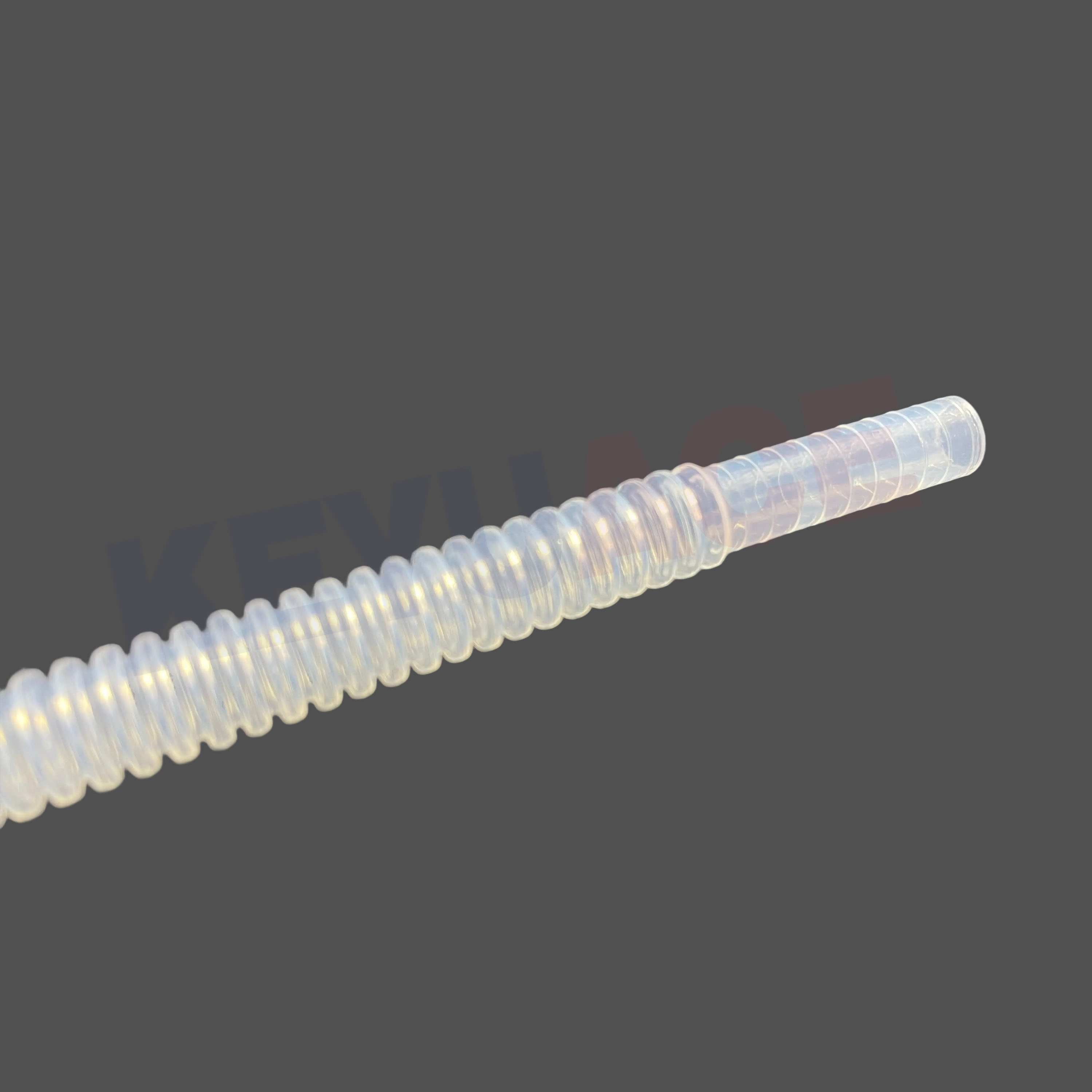
FEP Corrugated Tube is a flexible piping product made from Fluorinated Ethylene Propylene (FEP) copolymer, a member of the fluoroplastic family. Its core material, FEP, is synthesized by copolymerizing tetrafluoroethylene (FEP) and hexafluoropropylene (FEP), boasting exceptional chemical stability and thermal resistance. The molecular structure of this material enables it to maintain stability across a wide temperature range from -60°C to 200°C, with short-term heat resistance up to 260°C, while also resisting corrosion from strong acids, alkalis, and organic solvents.
Core Advantages
- Corrosion Resistance
FEP Corrugated Tubing exhibits almost no reaction with common chemicals, making it ideal for transporting corrosive media such as sulfuric acid and sodium hydroxide. It performs exceptionally well in piping systems within the chemical and pharmaceutical industries. - Transparency and Visibility
FEP material features high transparency, allowing direct observation of fluid conditions inside the tube to monitor liquid flow or gas pressure changes—a critical characteristic for laboratory equipment and medical applications. - Flexibility and Fatigue Resistance
The corrugated structure design endows the tube with excellent bending resistance, enabling it to adapt to scenarios involving pipeline displacement or equipment vibration, such as dynamic connections in heat exchangers. - Electrical Insulation
With a low dielectric constant (approximately 2.1), it serves as an ideal material for insulating sleeves in electronic devices, widely used in cable protection and high-frequency circuit components.
Typical Application Scenarios
- Laboratory Equipment
It connects reaction kettles and condensers, withstanding chemical reagents while facilitating observation of experimental processes. - Medical Devices
Medical catheters and endoscopic instruments rely on its biocompatibility and high-temperature sterilization resistance to minimize the risk of tissue damage. - New Energy Sector
In liquid cooling systems for data centers and battery cooling pipelines of new energy vehicles, Dankai FEP Corrugated Tube meets the dual requirements of high-temperature resistance and corrosion protection. - Industrial Piping
Chemical plants use it for acid-alkali transportation pipelines, and oil exploration operations adopt it for sampling water pipelines, effectively extending equipment service life.
Differences from Other Fluoroplastics
FEP, PTFE (Polytetrafluoroethylene), and PFA (Perfluoroalkoxy Alkane) all belong to the fluoroplastic family but exhibit distinct characteristics:
- Processing Performance: FEP has a lower melting point (approximately 260°C) compared to PTFE (327°C), allowing for extrusion and injection molding of complex structures, whereas PTFE requires sintering.
- Transparency: FEP and PFA are transparent, while PTFE is typically opaque.
- Maximum Temperature Resistance: PFA (260°C) has a higher heat resistance limit than FEP (200°C), but FEP offers superior flexibility.